

The 9th class result attracts less attention than Matric, and that is a mistake. SSC Part I marks are carried forward into the final Matric aggregate, so half of the number that decides your college admission is settled a full year before you sit Part II.
Checking your 9th class result 2026
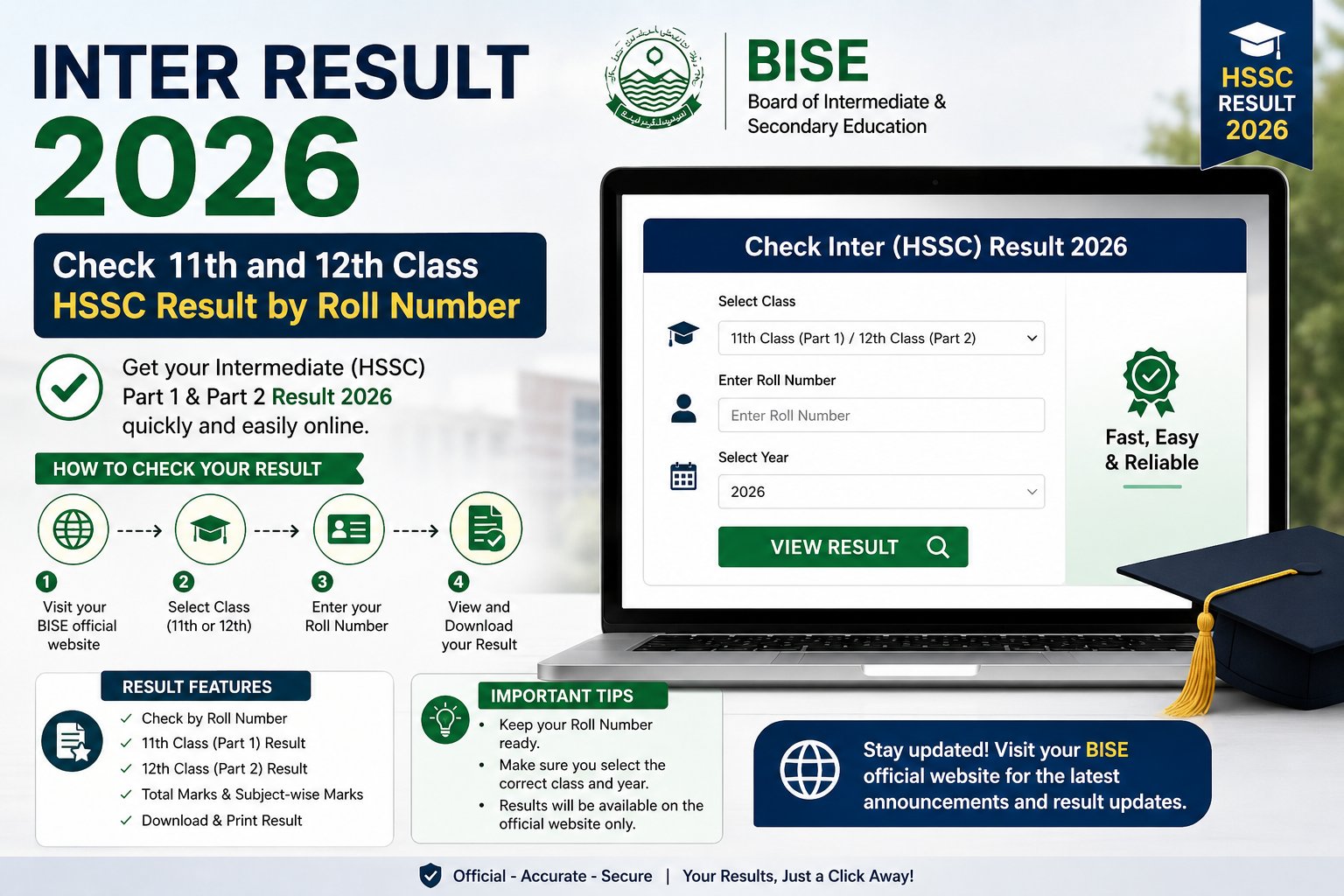
- Open your board's hub page — every board is listed at the end of this article.
- Enter your roll number and select 9th Class (SSC-I) in the checker.
- The official board result page opens with your subject-wise marks sheet.
- Save a copy. You will need these marks again when Part II results arrive.
If your roll number slip has gone missing, the result gazette is searchable by name — our guide to checking a result by name without a roll number explains the method, which works on every board.
When 9th class results are announced
SSC Part I results usually follow Part II by a short interval, landing in the July to August window. Some boards declare both parts on the same day; others separate them by a week or two. The board publishes the exact date and time in a press notification shortly beforehand, and our BISE result date guide covers how to distinguish that notification from the rumoured dates that circulate every season.
How Part I marks count
SSC Part I is marked out of 550, and Part II out of another 550, giving the 1100 total that your final Matric result is calculated on. Both halves weigh equally. A student who scores 400 in Part I needs a strong Part II simply to reach a percentage that a competitive college will look at, whereas a student on 480 has considerable room.
The pass mark is 33 per cent per subject as well as on the aggregate. A failed subject in Part I must be cleared — through the supplementary session — and it does not quietly disappear when Part II goes well.
This is the practical takeaway for 9th class students: your Part I marks are not a rehearsal. Work out where they put you now, using the Marks Percentage Calculator, and you will know exactly what Part II has to deliver.
Reading the marks sheet
Percentage, grade and division are three separate scales, and result day confusion almost always comes from mixing them:
- Grades — A1 at 80% and above, A at 70–79%, B at 60–69%, C at 50–59%, D at 40–49%, E at 33–39%, F below 33%.
- Divisions — 1st division from 60%, 2nd division from 45%, 3rd division from 33%.
They overlap without matching, so 62 per cent is a B grade and a 1st division simultaneously. Our explainer on how percentage, grades and divisions are calculated goes through the arithmetic, including the trap of averaging percentages across subjects with different totals.
If a subject went badly
Two options, and the choice depends on the size of the gap. Re-checking re-totals your paper — the board verifies that every question was marked and the addition is correct. It is not a re-marking, so it recovers marks lost to an error rather than changing an examiner's assessment. It is worth the fee for a gap of five or ten marks, rarely for thirty. Applications close 15 to 30 days after the result.
Supplementary examinations let you clear a failed subject a few months later without repeating the year. For a 9th class student this matters more than it sounds: clearing a Part I subject in supplementary keeps you on schedule for Part II the following year.
Check your board's 9th class result
- Sindh — Sukkur, Hyderabad, Larkana, Mirpurkhas, Karachi
- Punjab — Lahore, Sargodha, Rawalpindi, Multan, Faisalabad, Sahiwal
- Khyber Pakhtunkhwa — Peshawar, Swat, Mardan, Bannu, Malakand
- Every board in Pakistan



2 Comments
Leave a Reply